
Stocktag vs Rushlot for stock video metadata
Stocktag is an online studio that writes stock metadata and exports it as CSVs. Rushlot is a Mac and Windows app for stock footage sellers that also uploads the clips. Here is what each one does, from its own pages, with the date we read them.

At a glance
 Rushlot | Stocktag | |
|---|---|---|
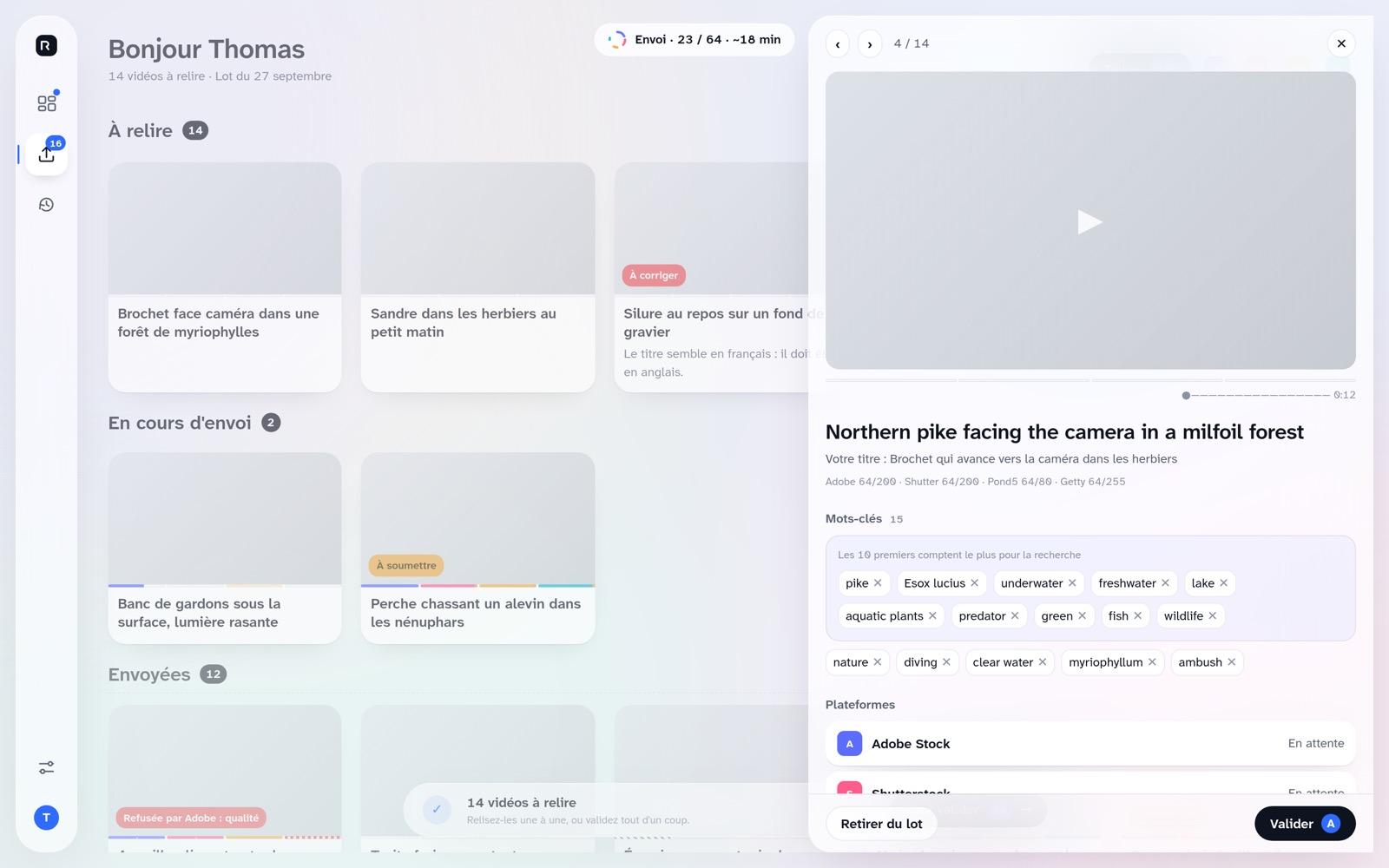
| What it is | For stock footage: one review, four marketplaces. Each clip is checked, its metadata drafted for each marketplace, and nothing is ever uploaded twice. | An online Metadata Studio: titles, descriptions and relevance-ranked keywords for a batch of files, with quality checks and rights and IP signals. [1] |
| Marketplaces from one review | Adobe Stock, Shutterstock, Pond5 and Getty Images from one review, to your own accounts: SFTP for Adobe Stock (qualified accounts), FTPS for Shutterstock and Pond5, Getty’s own uploader in your browser. | A ZIP with one CSV per platform, from ready-made formats including Adobe Stock, Shutterstock, Getty Images and Pond5. The pages we read describe no upload to a marketplace. [1] |
| A metadata set per marketplace | Titles, descriptions and keywords for each marketplace, drafted from your own title. You review them once, before anything leaves. | One set for every marketplace: its page says there is no need to rewrite the metadata for each one, and the export columns adapt to the platform you pick. [1] |
| Spec check and repair | Checked against each marketplace’s specs: frame rate, resolution, duration, codec. Any repair, like removing audio or re-encoding HEVC to H.264, is made on a copy. Your original is never touched. | MP4 and MOV. It “samples one frame per second”, at 1 credit per 5 seconds, rounded up, up to 120 seconds per clip. The pages we read do not describe spec checks, removing audio or re-encoding HEVC. [1][2] |
| Never uploaded twice | Never uploaded twice. Rushlot keeps its own record of each clip on each marketplace, and two clips that share a file name are both held back. | It removes duplicate keywords from a list. The pages we read do not mention a guard against uploading the same clip twice. [1] |
| Uploads for you | Uploads the files itself, to your own accounts. Nothing to export and carry over by hand. | You do. Its workflow ends with an export, as CSV, XMP or ZIP, which you import on each platform yourself. [1] |
| Metadata in the file | Title and keywords written into the video file as XMP, which Adobe Stock and Pond5 read. For Shutterstock and Getty, which do not, Rushlot fills the CSV import too. Measured on a real account, 2026-09-07, 2026-09-08, 2026-09-11 | CSV, XMP output or ZIP. The pages we read do not say metadata is embedded in video files. [1] |
- Rushlot does it
- Its page says it does not
- Its pages do not say
Where Rushlot differs
- Checked against each marketplace’s specs: frame rate, resolution, duration, codec. Any repair, like removing audio or re-encoding HEVC to H.264, is made on a copy. Your original is never touched.
- Adobe Stock, Shutterstock, Pond5 and Getty Images from one review, to your own accounts: SFTP for Adobe Stock (qualified accounts), FTPS for Shutterstock and Pond5, Getty’s own uploader in your browser.
- Title and keywords written into the video file as XMP, which Adobe Stock and Pond5 read. For Shutterstock and Getty, which do not, Rushlot fills the CSV import too. Measured on a real account, 2026-09-07, 2026-09-08, 2026-09-11
Which to choose
Choose Rushlot if your clips need checking and repair before upload, you work on a Mac or a Windows PC, and you want the files delivered to the four marketplaces, not only described.
How we checked
We make Rushlot, so we are not neutral. Every fact here about another company was read on that company’s own public pages on , without signing in, creating an account or starting a trial, and each one links to its source. Facts about Rushlot come from its own product rules and this site; a cell marked Measured was read on a real contributor account. Prices and features change, so check their pages before you decide. No logos, no ratings, no ranking.
Stocktag and every other product named here are trademarks of their owners. Rushlot is not affiliated with any of them. Found an error? Tell us at contact@rushlot.com.
Frequently asked questions
Its home page, read on 8 November 2026, says it samples one frame per second from MP4 and MOV clips. Rushlot drafts from your own title and a few small frames.
Its pricing page gives 1 credit per 5 seconds, rounded up, up to 120 seconds per clip. Rushlot checks each clip against each marketplace’s duration limits.
The pages we read describe exports, not uploads. Rushlot uploads clips to your own accounts on Adobe Stock, Shutterstock, Pond5 and Getty.
It exports CSV or XMP, and the pages we read do not say it writes to video files. Rushlot writes XMP into the video file right before upload.
For footage on Adobe Stock, Shutterstock, Pond5 and Getty Images, from a Mac or a Windows PC, yes: each clip is checked, repaired on a copy and uploaded to your own accounts.
Sources
More comparisons
- MyKeyworder vs Rushlot for stock video
- ImStocker vs Rushlot for stock video
- Xpiks vs Rushlot for stock video
- Wirestock alternatives for stock footage (2026)
- PhotoKeyworder vs Rushlot for stock video
- AutoKeyWorder vs Rushlot for stock video
- MetaMule vs Rushlot for stock footage
- SendStock AI vs Rushlot for stock footage
- StockSubmitter vs Rushlot for stock video
- MyKeyworder alternatives for stock video (2026)
- ImStocker alternatives for stock video (2026)
- Blackbox alternatives: sell footage from your own accounts
- AGKeywords vs Rushlot for Adobe Stock video
- Microstock+ vs Rushlot for stock video
- StockSubmitter alternatives for stock footage sellers
- ClipMeta vs Rushlot for stock footage metadata
- CyberStock vs Rushlot for stock video
- Exifio vs Rushlot for stock footage
- Software to upload stock footage to several agencies
- GenMeta vs Rushlot for stock footage metadata
- Meita.ai vs Rushlot for stock video metadata
- TagMyClip vs Rushlot for stock footage
- AI Stock Keywords vs Rushlot for stock video
- QuantumFolio vs Rushlot for stock submissions
- Xpiks alternatives with AI metadata included
- Microstock+ alternatives that keep your logins with you
- All comparisons, latest checked on 2026-11-14