
Are AI-written keywords allowed on stock sites?
No stock agency bans AI-written keywords. What Adobe Stock, Shutterstock, Pond5 and Getty penalize: spam, irrelevant words, brands. Dated rules, sources.

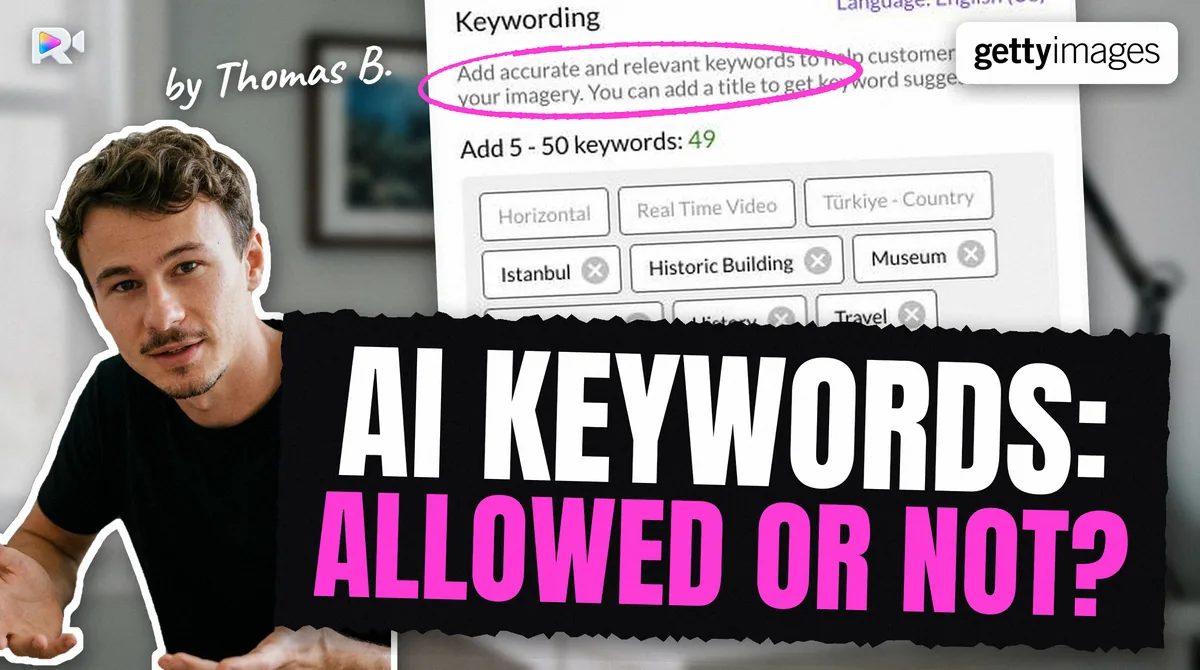
Yes, as far as any agency has said. In the pages we read in October 2026, none of Adobe Stock, Shutterstock, Pond5 or Getty forbids or allows AI-written keywords, and Adobe and Getty offer their own suggestions. What they penalize is what the words say: irrelevant keywords, repeated words, brand names and spam, though not every agency lists all four.
That is the useful answer, because it moves the question. The risk is not that a reviewer detects a tool. It is that an auto keyword tool produces exactly the words the rules forbid, and that you send them unread. This page lists what each agency actually penalizes, the ways AI keywords fail, and how Rushlot checks its own drafts.
Do Adobe, Shutterstock, Pond5 or Getty ban AI-written keywords?
No. We found no page at any of the four that bans or approves metadata written by AI. At least two of them even write keywords for you:
- Adobe Stock suggests keywords in its own uploader, up to 25 per file (Adobe help, "Keyword and title best practices").
- Getty has a "Get suggestions" button in ESP, its upload tool (seen on a live account on 2026-09-08).
Some AI keyword sellers write that "human reviewers reject unnatural metadata". We found no agency page that says so. Take it as marketing, not a rule.
One related rule does exist. For content that is itself made with generative AI, Adobe forbids naming real people or third-party intellectual property in the metadata (Adobe help, "Generative AI content"). That is about what the words name, not about who wrote them.
What do the agencies actually penalize?
The words, wherever they came from. Here is what each agency publishes.
| Agency | What is refused | How far it can go | Source (date) |
|---|---|---|---|
| Adobe Stock | Inappropriate or irrelevant keywords; logos, company names and brands in metadata | Spam "can even lead to your account being closed" | Common reasons for refusal (2026-06-11); Account and submission guidelines (2026-09-03); Artist Hub (read 2026-10-01) |
| Shutterstock | Repeated words or phrases; irrelevant or incomplete keywords; a list of words instead of a sentence (titles) | Re-adding a keyword its staff removed is a violation; repeated violations lead to suspension or termination | Rejected for title or keywords (2025-09-13); Keyword spamming (2025-07-18); Account guidelines (2025-09-23) |
| Pond5 | Stuffing titles or keywords "will result in rejection" | Not stated | Tagging & Pricing (read 2026-10-27) |
| Getty iStock | Keywords outside its controlled vocabulary stay red; "quality over quantity" | Keyword doping is forbidden by its contributor agreement | Article 6064 (read 2026-10-01); agreement 4872 (search extract); ESP measured 2026-09-08 |
Shutterstock gives the clearest definition: keyword spamming is "overusing repeated or irrelevant terms". The rows differ in detail, but they point the same way: a keyword must describe what a buyer will see in the clip.
How do AI keyword tools go wrong?
In six predictable ways. Most of them map to a rule above.
- Generic filler. Beautiful, amazing, background, concept. Asked for 49, a model fills 49. Irrelevant on every agency.
- Repeated stems. Swim, swimming, swimmer, swims. Shutterstock names repeated words as a rejection reason.
- Brands and camera names. GoPro, iPhone, a boat maker's name. Adobe forbids brands in metadata.
- Wrong species. A model names a plausible fish from the picture. If it is wrong, it is a false claim a buyer can check in seconds.
- The wrong language. Shutterstock wants English descriptions, apart from Latin names, places and common foreign terms (Contextual Metadata, 2026-02-26).
- Stray markup. A model can leave a tag or note in its output. One draft of ours opened a description with an invented tag ending in
>: Shutterstock refused the row, Adobe used it as the clip's title, and Pond5's page showed the clip with no title at all.
The last two happened to us. Both came from Rushlot's own early drafts, on the account of Hervé Berthou, my father, who had used ChatGPT for his metadata before. A French keyword, tonne de chasse, reached Shutterstock on one September 2026 batch: keywords were not yet checked for language.
Why is checking every AI keyword by hand so slow?
Because the checks multiply. Forty keywords, four agencies, each with its own count, its own language and character rules, and its own banned words: one clip means reading the list four ways. Most people stop reading after the first few clips, and that is when a brand, a wrong binomial or a French word slips through. The agency does not tell you which word was the problem, and on Shutterstock some words just disappear.
How does Rushlot check the keywords it drafts?
With three gates, each built after a real failure. They are described in full in how we check scientific names.
1. Your title is the source. You know what you filmed; a model looking at frames does not. Rushlot expands your title into keywords. A vision pass adds what a title cannot say (shot type, camera movement, light), and if it contradicts your title, it raises a flag for you. It never overwrites your words.
2. Every Latin name is checked against WoRMS. WoRMS, the World Register of Marine Species, holds freshwater species too. The rules, measured on 2026-09-03:
| WoRMS answers | What Rushlot publishes |
|---|---|
| HTTP 200, accepted name | The name |
| HTTP 200, name not accepted | The current valid name (Manta birostris becomes Mobula birostris) |
| HTTP 204 (no record) | Nothing. A typo (Esox luciuss) and an invented name (Sander fictus) both return 204 |
| No answer | Nothing. An outage is not a verdict |
When a name fails, Rushlot steps down to the genus, then the family, then a plain common noun. It never publishes a name it could not check.
3. Nothing leaves unread. Before upload, Rushlot reads the generated title and description (never your original title) and stops a clip whose text reads as French, carries markup such as < or >, has an empty title, or has a title too long for Pond5's 80 characters. Keywords are checked for markup. It runs the check twice: when it drafts, and again just before the upload starts. Since 27 September 2026, a keyword with a French accent or French function words is dropped and flagged, unless the English title uses the same words.
Two rules sit on top. The keyword count is a ceiling, never a quota: under 15 is flagged, never padded with guesses. And a stem is used once.
Brand and camera names are yours to check, with question 2 below.
How do I check AI keywords myself before upload?
Run the list through five questions, in this order:
- Can I see this word in the clip? If not, delete it.
- Is it a brand, a product, a person or a place I cannot confirm? Delete it.
- Is the Latin name in WoRMS (or GBIF, exact match only, for land species)? If not, use the genus or a common noun.
- Is any stem there twice? Keep one.
- Is the most important word in the first 10? On Adobe, keyword order counts: it has to be.
The tool below does questions 4 and 5 in your browser: it removes duplicates and repeated stems, keeps your order and shows Adobe's first 10.
Which AI keyword generators work on video?
Several do, and they differ on what happens to the file. On our survey of 8 November 2026, five tools centre on drafting stock footage metadata: AI Stock Keywords, AutoKeyWorder, ClipMeta, PhotoKeyworder and Stocktag. ClipMeta is built for video only, and also sends files by FTP to Blackbox. AI Stock Keywords and PhotoKeyworder say video metadata stays out of the file. SendStock AI says it embeds metadata in MP4 and MOV. We make one of these tools, so we rank none of them: our comparison of stock footage software lists each one from its own pages, and Rushlot vs ClipMeta sets two side by side. Every rule above applies whichever tool drafts the words.
What is still unknown?
That any agency detects AI-written metadata as such. No agency says it does, or that it doesn't. We have also not found any official statement that bulk-editing metadata puts an account at risk: one contributor on Adobe's forum reported a deactivation the day after correcting about 70 files (August 2026), with no official explanation that we could find.
Each agency has its own keyword limits, and Getty keeps only words from its controlled vocabulary. If you are choosing a tool, a good stock footage metadata generator has to do more than fill the keyword box. The head-to-head pages compare real ones: Rushlot vs MetaMule, Rushlot vs SendStock AI, Rushlot vs MyKeyworder. The agency pages (Adobe Stock, Shutterstock, Pond5, Getty Images) list each one's specs. The download page says how to get the Rushlot app for Mac and Windows.
Frequently asked questions
Adobe has no page that forbids or allows them in what we read. It refuses irrelevant keywords and says keyword spam can lead to an account being closed. Adobe's own uploader also suggests keywords. The tool is not the issue; the words are.
Not as such. Shutterstock refuses repeated words and irrelevant or incomplete keywords, defines keyword spam as overusing repeated or irrelevant terms, and treats re-adding a keyword its staff removed as a violation.
Yes, as a draft you check. Remove every word that is not visible in the clip, every brand, every repeated stem, and every Latin name you cannot verify. Keep the title in your own words.
Adobe says keyword spam 'can even lead to your account being closed'. Shutterstock's account guidelines escalate repeated violations to suspension or termination. iStock's agreement forbids keyword doping (read in a search extract).
They can invent or misspell them. Check every binomial against a taxonomic register such as WoRMS: a misspelt or invented name returns HTTP 204, and should be dropped.
We do not rank them, and we make one. Check three things on any tool: that it reads video, that it starts from your own title, and how the metadata reaches each agency. Only Adobe Stock and Pond5 read keywords embedded in the file.
As many as the clip supports, not as many as the field allows. Adobe calls 15 to 35 often plenty; Pond5 advises 10 to 20; Getty asks for quality over quantity.
Keep reading

Sources
- Adobe help, Common reasons for content refusal (updated 2026-06-11), read 2026-10-27
- Adobe Artist Hub, Maximize Metadata part 3 (undated), read 2026-10-01
- Adobe help, Account and submission guidelines (updated 2026-09-03), read 2026-10-27
- Adobe help, Generative AI content, read 2026-10-27
- Adobe help, Keyword and title best practices (keyword suggestions), read 2026-10-27
- Shutterstock help, Why was my content rejected for title or keywords? (2025-09-13), read 2026-10-27
- Shutterstock help, How are keyword and title spamming defined? (2025-07-18)
- Shutterstock help, Contributor account and content submission guidelines (2025-09-23), read 2026-10-27
- Shutterstock help, Content Publishing Standards: Contextual Metadata (updated 2026-02-26), read 2026-10-27
- Pond5, Tagging & Pricing Your Files, read 2026-10-27
- Getty Images, Content Partners guide, article 6064, read 2026-10-01
- WoRMS REST web service, AphiaRecordsByName
- Getty Images, Artist Supply Agreement, article 4872 (keyword doping), search extract read 2026-10-27
- Adobe Community, 'False positive account deactivation' (2026-08-07)
- Measured in Getty ESP on a live contributor account: 'Get suggestions' button, keyword rewrites, 2026-09-08
- WoRMS and GBIF answers for real, misspelt and invented names, measured 2026-09-03